
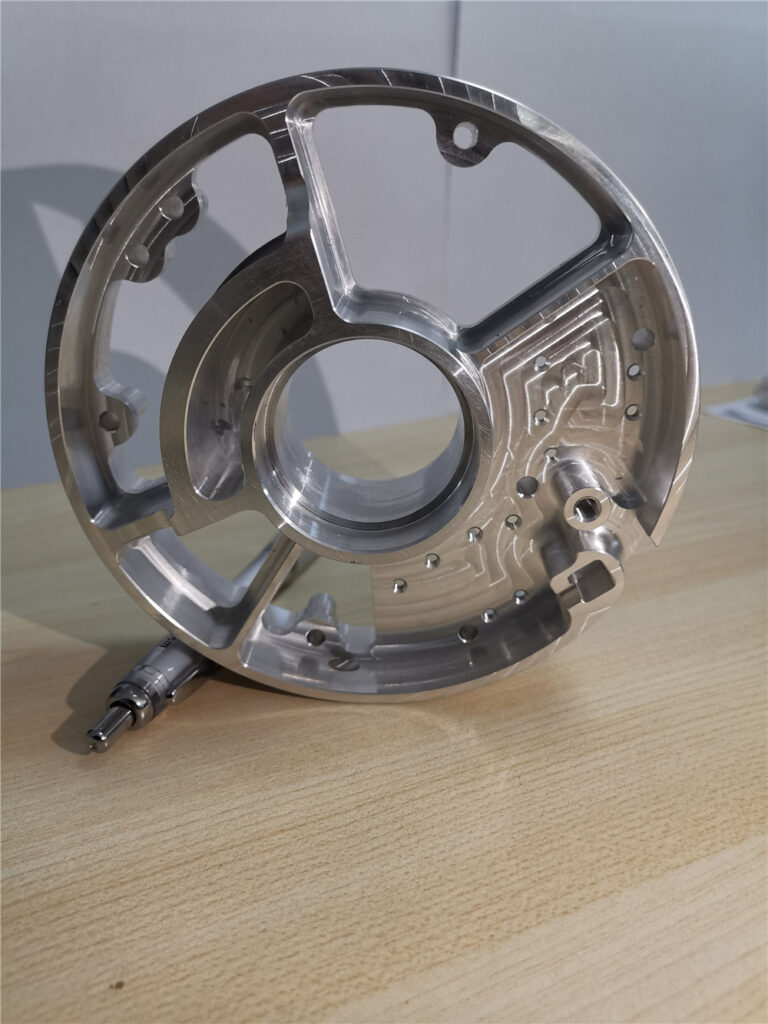
CNC Machining Services for Robotics and AGV/AMR Systems
Modern robotics systems — including collaborative robots, industrial arms, exoskeletons, AGV/AMR platforms — require structural and functional components that are light, rigid and dimensionally consistent. CNC machining remains the preferred manufacturing method due to its material flexibility, precision tolerances and short supply cycles.
This page provides an engineering overview for robotics OEMs, integrators and contract manufacturers who require parts with ±0.02 mm dimensional accuracy, consistent assembly interfaces and EU-grade finishing quality.
Why CNC Machining Fits Robotics Applications
Key engineering drivers include:
• Precision fits & datum control for rotational joints, housings and couplers
• High-strength alloys (e.g. 7075-T6, 17-4PH, 316L) for structural durability
• Lightweighting via pockets, ribs, lattices and topology-friendly machining
• Prototype → pilot → small batch continuity for platform validation
• Reliable finishing for corrosion, wear and assembly handling
Compared to casting, molding or additive, CNC delivers:
 tighter tolerances isotropic strength predictable QA/inspection stable supply for low-to-mid volumes
Typical Robotics Components We Machine
Robotics platforms involve mechanical parts across joints, powertrain and sensing interfaces. We routinely machine:
• Arm joints, couplers & bearing seats
• End-effectors, grippers & tool plates
• Motor housings & gearbox interfaces
• Sensor and camera brackets
• Safety enclosures & structural shells
• Wheel hubs and mecanum hubs (for AGV/AMR)
• Custom frames and mounting plates
For AGV/AMR supply chains, we also support:
• Drive motor brackets
• Servo mount interfaces
• Lidar/camera mounts
• Control box shells
• Battery modules and covers
Engineering Considerations for Robotics Parts
1. Materials for Structural Performance
Common materials by function:
Aluminum (6061-T6 / 7075-T6)
• Lightweight + high strength (7075 for load-bearing)
• Widely used for arms, joints, brackets, shells
Stainless Steel (304 / 316L)
• Wear, corrosion & marine AMR usage
• Used for shafts, fasteners, couplers
Tool Steel / 17-4PH / 4140
• High hardness for bearing journals or wear surfaces
2. Dimensional Tolerances & Fits
Robotics parts commonly require:
• ±0.02 mm for mating interfaces
• H7/h7 fits for bearings or precision shafts
• Flatness/parallelism for gearbox & motor mounts
• POS/PROFILE tolerances for multi-axis assemblies
3. Surface Finishing for Robotics
Finishing options include:
• ENP (Electroless Nickel) — wear + corrosion for housings
• Anodizing (Clear/Black/Hard) — aluminum protection + color coding
• Powder Coating — robust shells for AGV/AMR platforms
• Passivation / Black Oxide — stainless steel protection
Prototype → Bridge Production → Small Batch
Robotics hardware typically uses:
• frequent revisions during integration
• 10–500 pcs ranges
• BOM fragmentation across machining + sheet metal + assembly
Our machining workflow supports:
rapid prototypes (1–5 days) bridge runs for validation repeatable batches for pilot deployments
This is critical for robotics OEMs competing on product cycles and interoperability.
Supply Chain & European Compatibility
We understand requirements from EU robotics customers involving:
• drawing tolerances & datum schemes
• inspection documentation (COA/FAI)
• material traceability
• finishing conformity
• packaging for assembly cells
Result: shorter onboarding time + fewer engineering loops.
Supported Robotics Segments
We currently machine for:
• Collaborative robots (Co-bots)
• Exoskeletons & medical assist devices
• Autonomous logistics (AGV/AMR)
• Industrial manipulators
• Drone ground systems
• Research robotics & labs
Ready to Share Drawings?
Send your drawings or BOM for engineering review and quotation.
• Formats: STEP, IGS, XT, PDF
• Batch types: Prototype → Pilot → Small batch
• Industries: Automation, Robotics, Mobile platforms
• Materials: 6061/7075/316L/17-4PH/4140 etc.
EU customers welcome (automation + robotics supply chain).